How to choose the right light bulb for every room — without guessing.
Have you ever bought a beautiful table lamp, switched it on, and realized the light was too bright, too white, or simply not cozy?
The problem might not be the lamp. It might be the bulb.
Before buying your next light bulb, you only need to understand four things: Kelvins, lumens, CRI, and bulb compatibility. Here’s a practical guide you can refer to whenever you shop for home lighting.
1. Kelvins: Choose the Right Color of Light
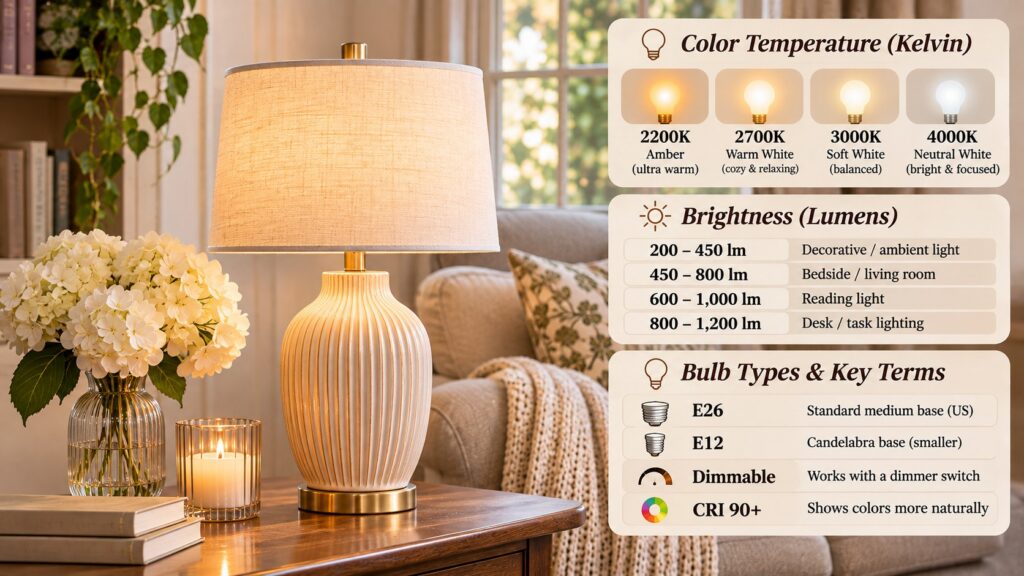
Kelvins (K) describe how warm or cool white light appears. Lower numbers produce warmer-looking light; higher numbers produce cooler-looking light.
| Color temperature | Appearance | Best use |
|---|---|---|
| 2200K | Very warm, amber | Decorative lamps, evening ambiance |
| 2700K | Warm white | Bedrooms, living rooms, vintage lamps |
| 3000K | Soft warm white | Kitchens, dining rooms, general lighting |
| 4000K | Neutral white | Home offices, utility areas, task lighting |
| 5000K | Cool daylight-like | Detailed tasks where cooler light is preferred |
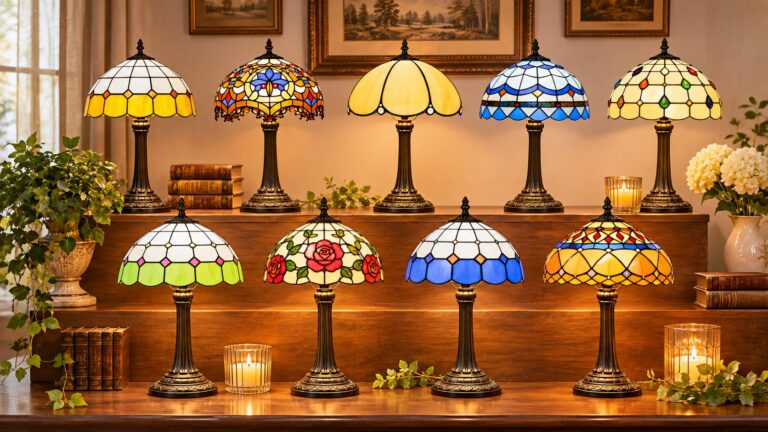
My recommendation: Start with a 2700K LED bulb for a cozy living room or bedroom. For Tiffany-style stained-glass lamps, 2200–2700K can create a beautiful warm glow, although the bulb’s color may change how the glass looks.
2. Lumens: How Bright Should Your Lamp Be?
Lumens (lm) measure the amount of visible light a bulb produces. Unlike watts, they tell you about brightness rather than energy consumption.
| What you’re using it for | Suggested bulb brightness |
|---|---|
| Decorative accent lamp | 200–450 lm |
| Bedside ambient lighting | 400–800 lm |
| Reading lamp | 600–1,000 lm |
| Desk task lighting | 800–1,200 lm |
| General room lighting | Depends on room size and number of fixtures |
These are practical starting ranges for individual bulbs, not universal requirements. A dark shade can reduce usable light, while a focused reading lamp may need fewer lumens than a heavily shaded one.
Important: For reading, the amount of light reaching the page matters more than the bulb’s advertised lumens.
3. CRI: Why Some Rooms Look Better Under Certain Bulbs
CRI stands for Color Rendering Index. It describes how accurately a light source renders colors compared with a reference source of the same color temperature.
- CRI 80+: A reasonable minimum for everyday home lighting.
- CRI 90+: A better choice when you care about artwork, textiles, wood finishes, and natural-looking colors.
For a stained-glass lamp, CRI 90+ is worth considering if you want the shade’s colors and nearby decor to look more natural. Remember that the colored glass itself also filters the light.
4. Bulb Bases and Compatibility in the United States
Before buying a bulb or an imported lamp, check its socket and electrical specifications.
| Marking | What it means |
|---|---|
| E26 | Common medium screw base in US household lamps |
| E12 | Smaller candelabra screw base |
| E27 | Similar-looking medium screw base used in many other markets |
| Dimmable | Bulb supports dimming with compatible controls |
| 120V | Common US household supply voltage |
An E27 bulb may physically fit some E26 sockets, but that does not automatically guarantee electrical compatibility.
For imported lamps, check the voltage rating, plug, socket, maximum permitted bulb wattage, and appropriate electrical safety certification. A plug adapter does not convert voltage. Ordering from AliExpress? My guide on how to read an AliExpress listing before you order shows exactly where to find these specs.
5. The Quick Room-by-Room Lighting Guide
| Room or location | Color temperature | What to prioritize |
|---|---|---|
| Bedroom nightstand | 2200–2700K | Soft glow, low glare |
| Living room side table | 2700K | Comfortable ambient lighting |
| Reading corner | 2700–3000K | Adjustable, well-directed light |
| Home office desk | 3000–4000K | Adequate task illumination |
| Dining room | 2700–3000K | Warm atmosphere, dimming |
| Decorative Tiffany-style lamp | 2200–2700K | Shade color and gentle ambiance |
For most homes, it’s useful to have several light sources instead of relying on one bright ceiling fixture. Here’s how I layer them in a small bedroom shared by two people. For kids’ rooms, I’d add a dim amber night light; here’s why in my girls bedroom ideas. For kids’ rooms, I’d add a dim amber night light; here’s why in my girls bedroom ideas.
6. What I Would Check Before Buying a Vintage Table Lamp
I love Tiffany-style lamps because their stained-glass shades can bring color and character to an ordinary room. But I wouldn’t choose one based on appearance alone.
Here’s my quick shopping checklist:
- Check whether the shade is real glass, resin, or plastic.
- Compare the listed dimensions with your nightstand or side table.
- Check customer photos with the lamp both switched on and off.
- Confirm the socket, voltage, plug, and maximum bulb wattage.
- Read recent reviews for brightness, packaging, and construction quality.
For a decorative vintage-style lamp, I’d usually start with a warm 2700K LED bulb, then adjust the brightness depending on the shade and location.
The One Rule Worth Remembering
Kelvins control the color of light. Lumens control brightness. CRI helps describe color accuracy. And compatibility determines whether a bulb is suitable and safe for your lamp.
Once you understand those four things, choosing home lighting becomes much easier.
If you love warm, character-filled interiors, explore my collection of 9 Tiffany-style vintage table lamps for inspiration.