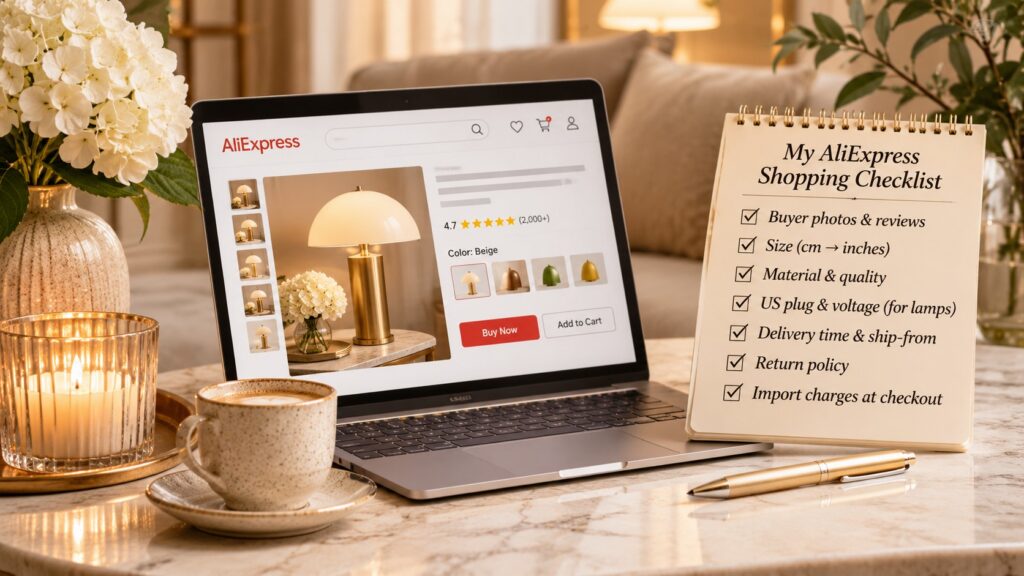
Most decor orders go wrong in the five minutes before you click “Buy,” not when the package arrives. I spend a lot of time going through home decor listings, and the same four gaps cause almost every disappointment: a size that looks bigger in the photo, a material described in one vague word, a delivery date nobody checked, and a return policy nobody read.
This is the routine I run on every listing before I trust it. It takes about ten minutes, and it works the same for a $12 vase or a $150 mirror. Where the rules change fast, mainly duties for US buyers, I tell you what to check yourself instead of promising a number that may be out of date by next month. You can see it in action in my Afrohemian living room on a budget picks.
Step 1: Trust buyer photos before seller photos
Seller photos show the best case, shot under studio light and often edited. Buyer photos show what actually lands in a normal living room, so I scroll to the reviews first and filter for reviews with photos. My rule for any decor piece: I want to see a few buyer photos taken in a real home before I buy.
What I look for:
- Color. Compare three or four buyer photos in different lighting. If a “sage green” looks gray in all of them, believe the buyers.
- Scale. Find a photo with something familiar next to the item, such as a sofa arm, a door handle or a hand. This tells you more than the size chart does.
- Newest reviews. Sort by latest. Sellers change suppliers, and a review from two years ago can describe a different product.
- Low-star reviews first. Read the 1–3 star reviews and look for repeated complaints: arrived chipped, smaller than expected, strong smell, color off.
- The variation label. Check that the reviewer bought the same color and size you plan to order.
- Where buyers live. Reviews from US buyers show how long delivery really took to the US.
A 4.8 rating from 6 reviews tells me far less than a 4.7 from 2,000. Be careful with a listing that has only short, generic five-star reviews or buyer photos that look like stock images.
Step 2: Turn centimeters into a real object in your room
Decor listings give sizes in centimeters, and the photo almost never shows scale. Divide by 2.54 to get inches, or use this quick reference:
| Centimeters | Inches |
|---|---|
| 20 cm | 7.9 in |
| 30 cm | 11.8 in |
| 40 cm | 15.7 in |
| 50 cm | 19.7 in |
| 60 cm | 23.6 in |
| 80 cm | 31.5 in |
| 100 cm | 39.4 in |
| 120 cm | 47.2 in |
Then make the number physical before you order:
- Mark it out. Cut paper or use painter’s tape to outline the width and height on the wall or floor. A mirror that seems “medium” on screen can look huge once it is taped up. For furniture, my spacing cheat sheet gives the clearances to tape out.
- Read the size chart for your variation. Many listings sell several sizes under one title, and the main photo may show the largest.
- Check what is included. Does the measurement include the base, the frame or the cord? Is it one piece or a set of three?
- Allow some tolerance. Sellers often note a small measuring error. For a tight fit, such as a shelf niche, leave extra room.
- Compare diameter with height. A vase can be tall and narrow or short and wide at the same volume. Look at both numbers.
- Textiles. For curtains and throws, check the size of one panel and how many panels come in the order.
Step 3: Decode the material and check the electrics
One vague word in the title usually hides the real material, so I open the “Specifications” table and the description and look for the actual material name. Words that make me slow down:
- “Marble pattern,” “wood grain,” “crystal style”. These often mean a printed finish, resin, MDF or acrylic rather than the real thing.
- “Faux,” “imitation,” “PU leather”. Honest labels, but not what the photo suggests at first glance.
- “Gold color” versus “plated”. Plated or painted finishes can wear at the edges, so I do not expect the same look in a year.
- “Metal” with no further detail. Ask the seller whether it is iron, aluminum or zinc alloy, because the weight and finish differ.
Two more clues. First, the weight: if a vase the size of a melon is listed at 200 g, it is not solid ceramic. Second, smell: new resin and PVC items can have a chemical odor, so I air them out before placing them in a bedroom.
For lamps and anything that plugs in, check these before you order:
- The plug and voltage. US outlets are 120 V. Look for a US plug, or a power adapter marked for 100–240 V.
- The bulb base. US sockets take E26 bulbs. Make sure the lamp is sold with a bulb that fits, or that it is built-in LED. My lighting cheat sheet explains bulb bases, Kelvins and lumens.
- Safety marks. I prefer lights with a recognized safety mark such as UL or ETL on the product or in the buyer photos. A mark in the listing alone does not prove anything, so I treat it as one clue.
- Where it will sit. For a bedside table or a child’s room I stay with listings that have clear buyer photos of the plug and label.
Do not assume a decor vase or mug is food-safe unless the listing says so.
Step 4: Set your country first, then read the delivery window
Before I judge any price, I set the “Ship to” country to the United States at the top of the page. Shipping options, costs and delivery estimates change with it, and some items simply do not ship to the US.
Then I compare the three common routes. These ranges are typical, not promises, so your order page always wins.
| Route | Typical delivery to the US | What to know |
|---|---|---|
| Ships from a US warehouse | A few days to about a week | Often the safest choice for decor; filter by “Ships from: United States” |
| Standard shipping from China | About 2–5 weeks | Cheapest; tracking can be patchy |
| Express (DHL, FedEx, UPS) | About a week or less | Paid extra; check whether duties are handled |
Three habits that save me from surprises:
- Read the estimated delivery window, not the processing time. A seller can take several days to ship before the parcel even starts moving.
- Screenshot the delivery estimate on the product page and at checkout. It is your evidence if the parcel is late.
- For gifts and seasonal pieces, count backward. If you need a wreath by December 15, an item from China is a risk and a US warehouse listing is not. Planning holiday decor? See my Christmas tree trends for 2026.
Step 5: Know your return rights before you pay
AliExpress has two separate safety nets, and they are easy to mix up. Check both on the listing page.
- Buyer Protection. According to AliExpress, you can get a refund if the item does not arrive within the guaranteed delivery window shown on your order page, or if it arrives damaged or not as described. For damaged or not-as-described items, the commonly cited limit is 15 days after you receive it, so inspect the package the day it comes.
- Free Return. Some listings carry a “Free return” label, and its time limit is printed on the listing itself. Windows and conditions differ by item and seller, and items usually must be unused and in original packaging. Without this label, the seller’s own terms apply and a return can mean paying the shipping yourself.
Before ordering, I check three things:
- Is there a Free Return label, and how many days does it give?
- Who pays return shipping if the item is wrong or damaged?
- Is the item fragile? Glass, ceramic and mirrors are the pieces most likely to arrive broken, and a heavy item is expensive to send back.
When the package arrives, I open it on camera, photograph the damage next to the shipping label, and file the claim from the order page the same day, with the evidence attached. Do not close a dispute until the refund has actually reached you.
Policies change, so read the current terms on the AliExpress Buyer Protection page rather than relying on this article alone.
Step 6: Find out who pays the import charges
The old advice, “keep the parcel under $800 and forget about customs,” no longer applies to US buyers, because low-value parcels from China no longer clear duty-free. US trade rules have also shifted several times since, so I will not quote you a percentage that could be wrong next month. Check it on the order itself.
- Look at the checkout screen. Some US listings now describe import charges as included or add an import-charge line before payment. Others do not. AliExpress’s own help says duties and taxes are typically not included in the item price, so the order summary is what counts.
- Screenshot the product page, the cart and the final summary. If a carrier later asks you for duty, those images show what you were told when you paid.
- Buyer Protection is not customs protection. A duty bill from a carrier is a separate matter from a refund for a damaged item.
- Price the real total. Add the item, shipping and any import charge, then compare it with a similar item on a US retailer. For a large or fragile piece, the “cheap” version may not be cheaper.
- Prefer US warehouse listings when the price is close. They usually avoid the border step for you, but confirm the ship-from location on the order page.
I am not a customs or tax advisor, so for large orders check the current rules on the US Customs and Border Protection website.
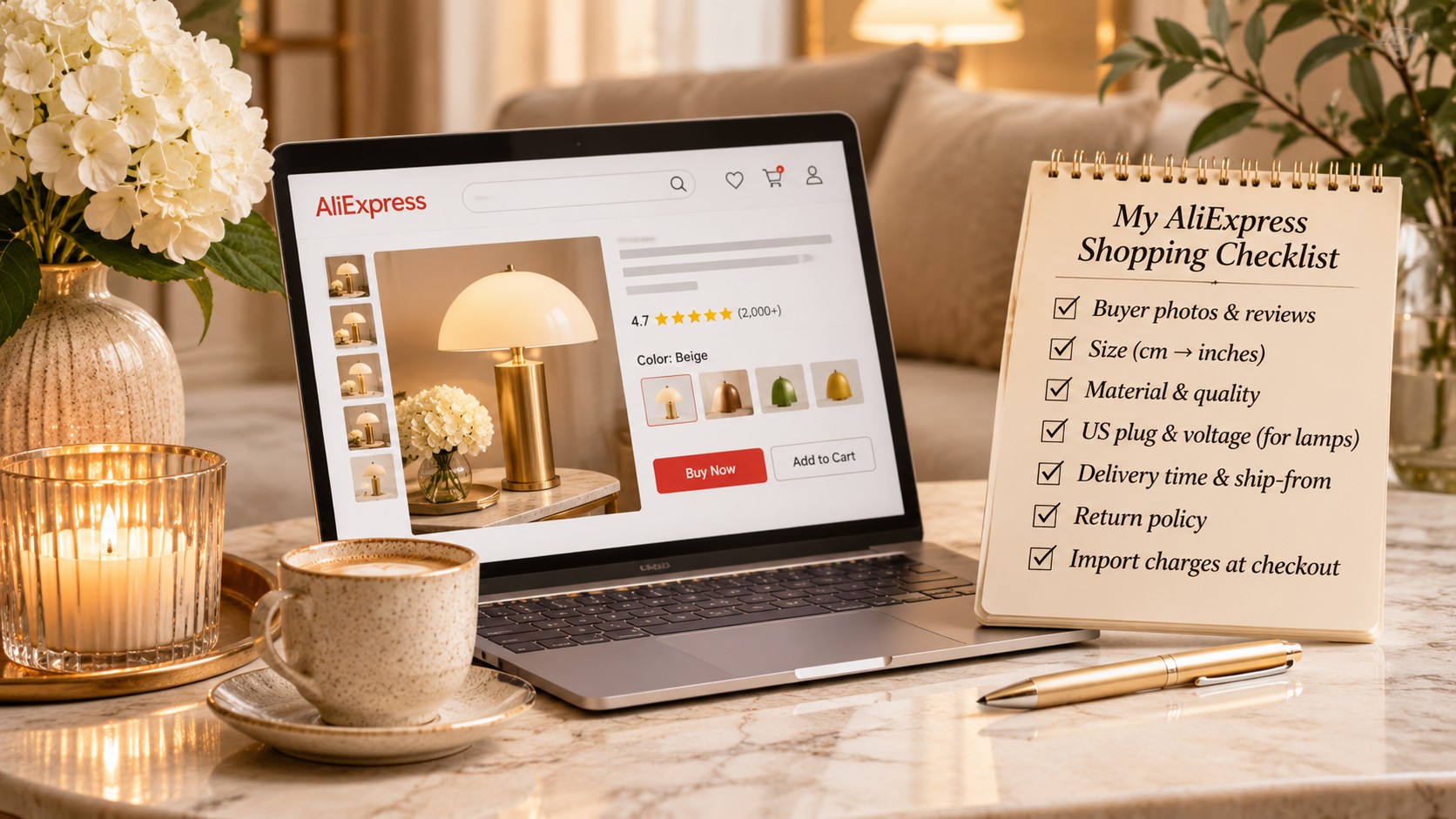
My 10-minute checklist before I click Buy
- ☐ Ship-to country is set to the United States
- ☐ I read buyer photos, including 1–3 star reviews, from the last few months
- ☐ I converted the size to inches and taped it out in my room
- ☐ I found the real material in the specifications, not just the title
- ☐ For lamps: US plug or 100–240 V adapter, E26 bulb base, a safety mark in buyer photos
- ☐ I know the ship-from location and the estimated delivery window
- ☐ I screenshotted the delivery estimate and the final order summary
- ☐ I checked for a Free Return label and who pays return shipping
- ☐ I know whether import charges are included at checkout
- ☐ The real total still beats a US retailer
If a listing passes all ten, I order with confidence. If it fails two or three, I move on, because there is always another one.