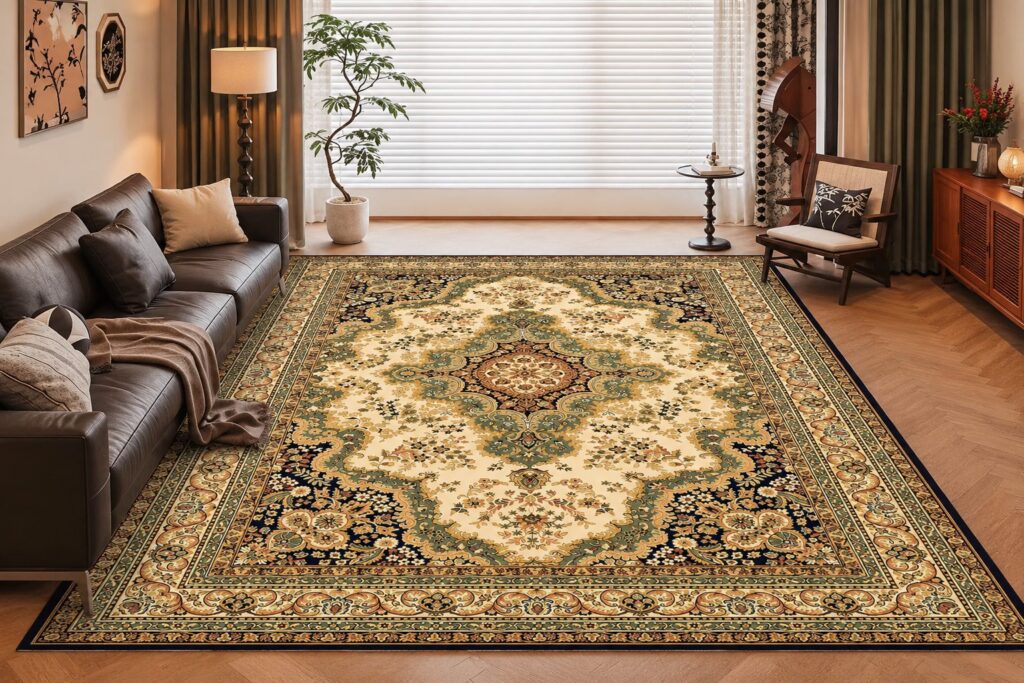
A vintage rug is the fastest way I know to make a new room look like it has a story. One rug can warm up a white-box apartment, tie together mismatched furniture and hide the everyday wear that ruins a plain carpet in a month.
In this guide I explain what "vintage" actually means (it's stricter than most listings suggest), which patterns and colors define the look, which homes it suits, why Americans are buying it right now, and how to choose one that lasts. After each section I've added a rug I'd pick for that look.
What a vintage rug actually is
A true vintage rug is at least 20 years old. That's the line Etsy, one of the largest US marketplaces for vintage goods, draws in its rules: vintage means "items that are 20+ years old", and a newer item "designed to appear vintage" doesn't qualify (Etsy Creativity Standards).
In practice you'll meet three kinds of rugs under the word "vintage":
| Type | Age | What you get | Typical buyer |
|---|---|---|---|
| Antique | Usually a century or more | Hand-knotted wool, collector value | Collectors, investment |
| Vintage | 20+ years | Real patina, softened colors, one of a kind | Design lovers who don't mind some wear |
| Vintage-style | New | The faded, worn look printed or woven in; often washable | Families, renters, pet owners |
The patterns themselves are centuries old. Under Persia's Shah 'Abbas (ruled 1587–1629), carpets were part of the state's economic program, and patterns were drawn in court workshops before weavers copied them across the region (The Met). The famous Ardabil carpet in London's V&A museum is dated 1539–1540 and has about 5,300 knots per 10 cm square, roughly 340 knots per square inch (V&A). That density is why old wool rugs survive generations of foot traffic.
The rugs I link in this guide are vintage-style: new, affordable, and made to look aged. For most living rooms that's the practical choice.
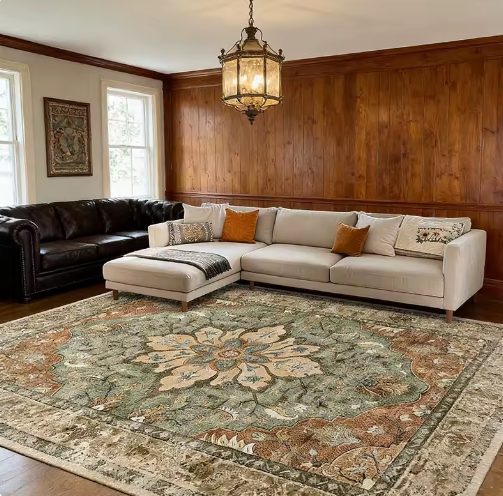
My pick for a traditional room: a sage-and-rust medallion rug that looks right next to wood paneling and a leather Chesterfield.
What defines the vintage rug look
You can spot the style by four things: a traditional pattern, a muted palette, visible wear and a flat, low pile.
Patterns from the old weaving centers. The big central medallion with a wide border comes from Persian court carpets. Repeating small flowers or geometric "all-over" fields come from Turkish and Caucasian village rugs. Ushak in western Turkey was one of the centers where the Ottoman court style spread (The Met), and "Oushak" is still a sales term for soft, pastel versions of these patterns.
Sun-faded colors. Real vintage rugs lose saturation over decades, so reds turn rust and coral, navy goes to slate blue, and greens go sage. Today's vintage-style rugs copy that faded palette on purpose.
Abrash and wear. Abrash is the uneven color banding you see when hand-dyed wool batches don't match exactly. Worn, low spots where the pattern almost disappears are part of the look, not a flaw.
Low pile. Most vintage rugs are flat or under half an inch thick, so doors open over them and furniture sits level.
When I shop, I squint at the photo: if the pattern still reads as a medallion or border but the colors look like they've been in a sunny room for 30 years, it's the right look.
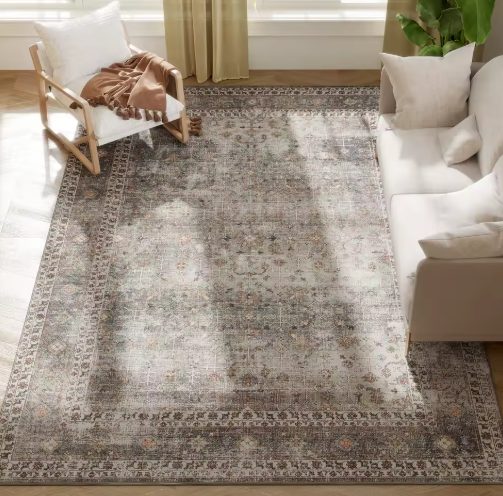
My pick for a light, airy room: a gray, faded Persian-pattern rug that softens a white Scandinavian space without adding color.
Which homes and apartments vintage rugs suit
Almost any home, which is exactly why I recommend them so often. What changes is the color and pattern you pick:
| Home style | What to choose | Why it works |
|---|---|---|
| Traditional, colonial, wood-paneled | Rich medallion in rust, green or navy | Matches the age and warmth of the architecture |
| Modern farmhouse | Faded gray, beige or sage, all-over pattern | Adds softness to white walls and shiplap without competing |
| Minimal or modern apartment | One bold medallion in blue or terracotta | The only patterned piece becomes the focal point |
| Rental with old floors | Large, low-pile, washable rug | Covers worn floors and goes with you when you move |
| Home with kids or pets | Busy pattern in mid-tones | Wear, stains and fur disappear into the design |
Size matters more than pattern. These are the sizes I use:
Living room with a standard sofa: 8 × 10 ft, with at least the front legs of the sofa and chairs on the rug.
Small apartment living room: 5 × 8 ft under the coffee table, with the sofa legs just touching the edge.
Under a queen bed: 8 × 10 ft, so about two feet show on each side.
Dining room: at least 2 ft wider than the table on every side, so chairs stay on the rug when pulled out.
The most common mistake I see is a rug that floats in the middle of the room. If no furniture touches it, it's too small. For the exact distances between sofa, coffee table and rug, see my furniture spacing cheat sheet.
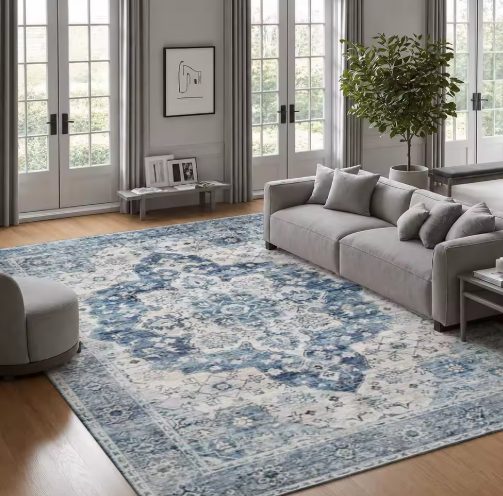
My pick for a modern living room: a blue-and-ivory medallion rug that gives a gray sofa and white walls a focal point.
Why vintage rugs are so popular in America right now
I see four reasons, and they reinforce each other:
Secondhand went mainstream. Resale is now a $393 billion global market and is "growing faster than retail overall", according to ThredUp's 2026 Resale Report (ThredUp). Once people get used to buying pre-loved clothes, a pre-loved rug feels normal.
People find decor on social feeds. The same report says nearly half of shopping discovery now happens across social feeds and creators. A faded Persian rug photographs beautifully, so it shows up again and again in home tours and pins.
It fixes the "new build" problem. Many new homes and apartments have the same white walls and light floors. A rug with an old pattern adds the character the architecture doesn't have, and you can take it with you.
Vintage-style finally got practical. Low-pile, washable reproductions mean you can have the look in a busy family room without worrying about a priceless heirloom.
The result is a style that works for both a collector with a hand-knotted 1960s Oushak and a renter with a washable copy. Both get the same lived-in warmth.
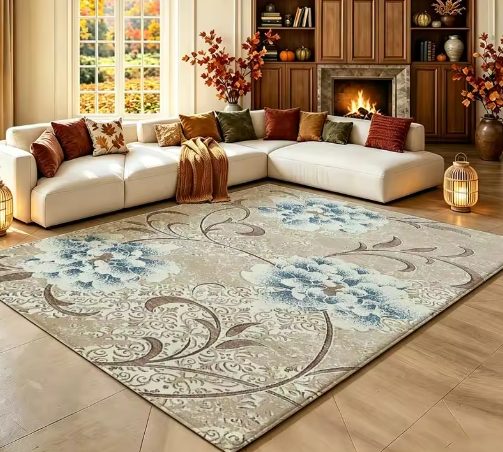
My pick for a cozy, warm room: a beige rug with soft blue florals that pairs with cream sofas, wood shelving and autumn-toned pillows.
How to choose a vintage rug and make it last
Before you click "buy", check these five things in the listing:
Exact size in feet or inches, not just "large". Measure your room with painter's tape first.
Pile height. Under 0.5 in is easiest to vacuum and won't block doors.
Material. Wool is durable and naturally hides dirt; polyester is cheaper and often machine-washable.
Backing. A non-slip back or a separate rug pad keeps it flat.
Real photos. Look for photos in a room, not only flat product shots, so you can judge the true color. My guide to reading AliExpress listings shows how to spot renders.
The rug pad is not optional for me. The CDC lists throw rugs among home hazards that cause falls, and more than one out of four older adults falls each year (CDC). A thin felt-and-rubber pad stops slipping and curled corners, and it also protects the floor underneath.
My care routine:
Vacuum weekly without the beater bar (or with it raised), so fringe and fibers don't get pulled.
Rotate the rug 180° every six months. Sun and foot traffic fade one side faster.
Blot spills right away with a dry white cloth; never rub, it spreads the stain.
Washable rugs: cold, gentle cycle and air-dry flat. Heat can shrink the backing.
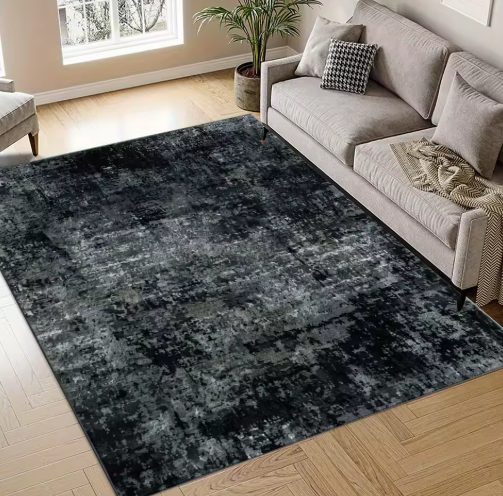
My pick for pets and kids: a charcoal, distressed rug with an abstract wash. It isn't a traditional pattern, but the faded, worn texture gives the same vintage feel, and dark mid-tones hide fur and everyday dirt.
Sources
Carpets from the Islamic World, 1600–1800: The Metropolitan Museum of Art
The Ardabil Carpet: Victoria and Albert Museum
Resale Report 2026: Top 10 Themes: ThredUp
Older Adult Falls: Facts and Stats: Centers for Disease Control and Prevention
This post contains affiliate links. If you buy through them, I may earn a small commission at no extra cost to you.