A small bedroom for two works when you plan it in inches, not in vibes. Two people means two sets of clothes, two alarm times, two ideas of “too warm” and one bed that eats most of the floor.
I’ve lived in a 10 × 11 ft bedroom with my partner for years, and every tip below is something I measured, tested or paid for. You’ll get the bed math, a floor plan you can copy, a storage split and a checklist to print.
1. Pick the bed by the room, not the showroom
A queen is the sweet spot for most small rooms: it gives each of you 30 inches and fits a room just 9 ft wide. Mattress sizes in the US are standardized, and the Sleep Foundation recommends about 24 inches of open floor on each side of the bed. I added that 24 in to both sides and the foot to get the smallest room each bed really needs.
| Bed | Mattress (in) | Width per person | Smallest room with 24 in clearance |
|---|---|---|---|
| Full | 54 × 75 | 27 in | 8 ft 6 in × 8 ft 3 in |
| Queen | 60 × 80 | 30 in | 9 ft × 8 ft 8 in |
| California king | 72 × 84 | 36 in | 10 ft × 9 ft |
| King | 76 × 80 | 38 in | 10 ft 4 in × 8 ft 8 in |
Two numbers surprised me:
- A full gives each of you only 27 inches. That is 11 inches less than one person gets on a twin (38 in wide). For two adults, I’d skip the full unless the room is under 9 ft wide.
- A California king is narrower than a regular king (72 vs 76 in) but 4 inches longer. In a narrow, deep room it fits where a king doesn’t.
My rule: measure the room’s short wall first. Under 9 ft → full or a queen pushed into a corner. 9 to 10 ft → queen. Over 10 ft 4 in → you can think about a king. And if you’d rather make the bed the art piece of the room, here are 10 unusual sculptural beds I found, from under $2,000.
2. Copy this floor plan for a 10 × 11 ft room
This is the layout I’d use in almost any 10 × 11 ft bedroom: the bed centered on the long solid wall, shelves instead of nightstands, and the dresser on the door wall.
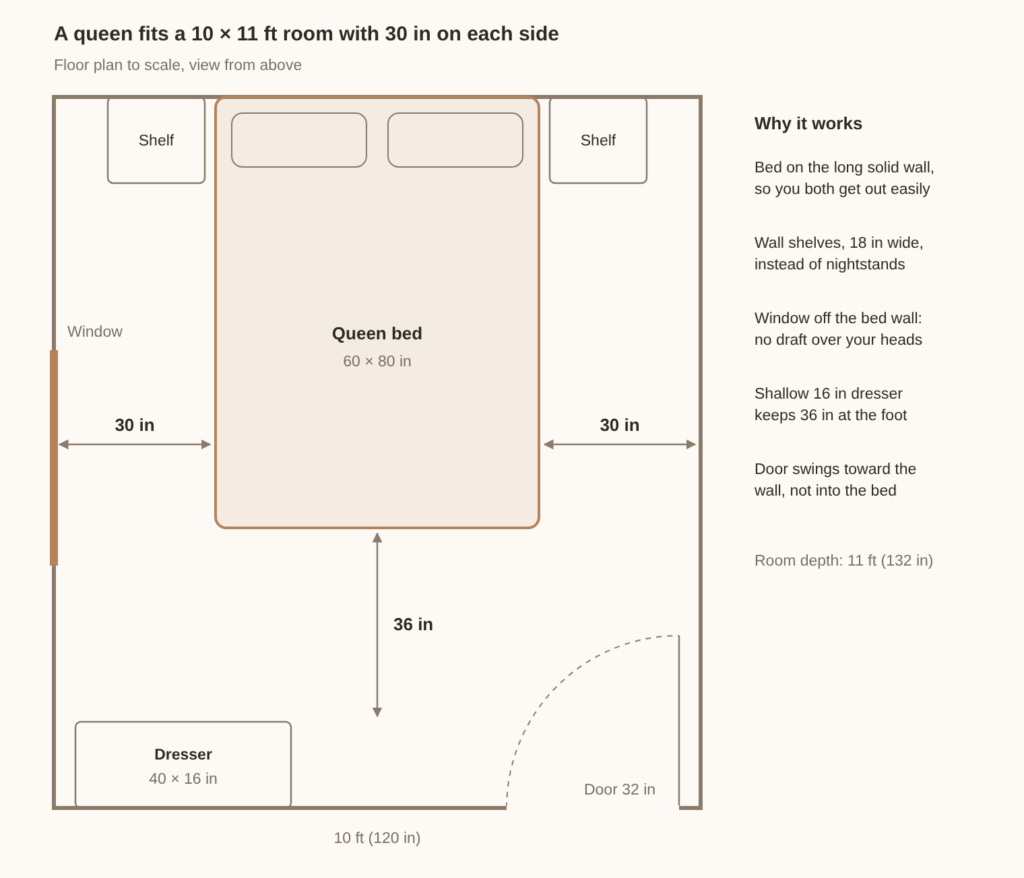
If your room is narrower than 9 ft, keep the same plan but push the bed into the corner farthest from the door. You lose one side’s walkway, so the person who gets up later sleeps on the wall side.
Before you move any furniture, tape the outline of the bed and shelves on the floor with painter’s tape and live with it for a day. It’s the cheapest way to find out a dresser drawer hits the bed frame. I use the same tape trick for living rooms too; the exact clearances are in my furniture spacing cheat sheet.
3. Solve the sleep problems before the decor ones
In a small room you can’t escape your partner’s snoring, phone light or body heat, so these fixes matter more than any pillow. More than a third of Americans now sleep apart from their partner at least some nights, according to a 2023 American Academy of Sleep Medicine survey (CBS News). Most of these fixes cost under $50 and keep you in one bed.
- Two duvets, one bed. Two twin-size duvets on a queen end the blanket tug-of-war and let the warm sleeper use a lighter one. Make the bed with one coverlet on top and it still looks like one bed.
- Set the thermostat to 65–68°F. That is the range the Sleep Foundation cites from doctors. A small room heats up fast with two bodies in it, so I keep a quiet clip-on fan on the warmer sleeper’s side instead of cooling the whole room for both.
- Mask the noise, don’t fight it. In one study of patients with trouble sleeping, white noise helped them fall asleep 38% faster (Sleep Foundation). A fan or a $20–$30 white-noise machine on the light sleeper’s nightstand covers snoring and street noise.
- Make it truly dark. Light from evening screens and lamps can delay your body clock and make you fall asleep later (Sleep Foundation). The Sleep Foundation’s advice is simple: “it is best to sleep in darkness with no lights on” (source). Blackout lining behind your curtains and a contoured sleep mask for the early sleeper do most of the work.
- Same mattress, two firmness levels. If you disagree on firmness, a split-firmness mattress or a 2-inch topper on one side costs far less than a bigger bed and takes zero extra floor.
4. Split storage 50/50, then go under and up
The space under a queen is 60 × 80 inches: 33 square feet, as much floor as a walk-in closet. Most couples leave it empty. Here is how I divide storage so nobody’s things spill onto the other’s side:
- Split the closet in inches, not “halves”. Measure the rod and give each person the same length, then mark the line with a different-colored hanger or a rod divider. When one of you needs more hanging space, the other gets more drawer space in return.
- Use slim velvet hangers. They are thinner than plastic or wooden ones, so the same rod holds noticeably more. It’s the cheapest closet upgrade I’ve made.
- Under the bed: one drawer per person. Two rolling bins, each about 30 in wide, fit side by side under a queen. Measure the gap under your bed frame and compare it with the bin height before you buy; if it’s too low, bed risers fix it.
- Wall-mount the nightstands. A floating shelf 18 in wide frees the floor under it, and the room looks bigger when you can see more floor. Hang it level with the top of your mattress so you can reach it lying down.
- Go up above the door. A shelf 12 inches above the door frame holds out-of-season bedding and bags. It’s dead space in almost every bedroom.
- One shared “drop zone”. A single tray on the dresser for keys, watches and earbuds stops both nightstands from filling with clutter.
5. Light it for two schedules
If one of you reads late or gets up at 5 a.m., the light plan matters more than the paint color. Even light of 10 lux or more late in the day has been linked to more waking at night and less deep sleep (Sleep Foundation). That is roughly a dim hallway light.
- One plug-in wall sconce per side, each with its own switch. It frees the nightstand, and the light falls on your book, not on your partner’s face. Pick one with an arm or a shade that points down.
- Warm bulbs, 2700K or lower. Cool white light reads as daytime. Warm light makes a small room feel softer, too.
- A motion night light at floor level for whoever gets up at night. It lights the path at ankle height and doesn’t wake the person in bed.
- Smart bulbs or a dimmer on the ceiling light. The early riser can bring the light up slowly instead of flipping on full brightness.
- Mirror across from the window, not the bed. It doubles the daylight and makes the room look deeper, but it won’t bounce streetlight onto your pillows at night.
6. Your weekend checklist
Print this, grab a tape measure, and do it in this order. The first steps are free and decide what you buy later.
- ☐ Measure the room’s short wall, long wall and the door swing
- ☐ Check the bed against the table in section 1
- ☐ Tape the bed and nightstands on the floor with painter’s tape and walk around them for a day
- ☐ Split the closet rod in inches and mark the line
- ☐ Measure the gap under the bed before buying bins
- ☐ Swap to two duvets and set the thermostat to 65–68°F
- ☐ Add blackout lining and one white-noise source
- ☐ Hang one sconce per side, each with its own switch
Decorating a child’s room next? Here are 12 girls bedroom ideas from toddler to teen.
Decorating a child’s room next? Here are 12 girls bedroom ideas from toddler to teen.
Sources
- Mattress Sizes 101: Sleep Foundation
- Best Temperature for Sleep: Sleep Foundation
- Bedroom Environment: Sleep Foundation
- How Noise Affects Sleep: Sleep Foundation
- Sleeping With the Lights On: Sleep Foundation
- More than a third of Americans have a “sleep divorce,” survey finds: CBS News, on the 2023 AASM survey